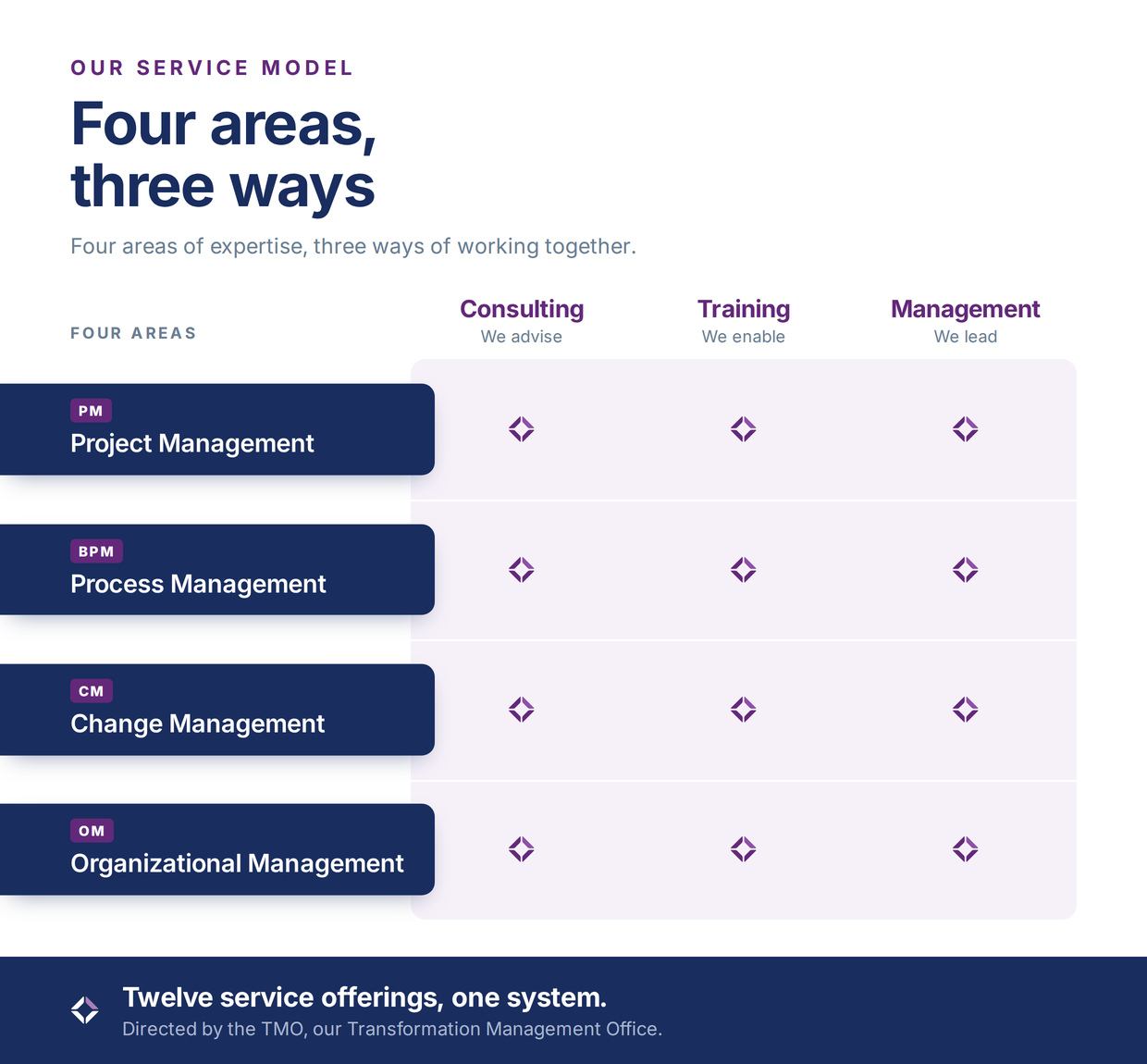
Successful transformation needs both: the right topics and the right form of collaboration. This page shows our complete service model in context: four areas of expertise, three service types, twelve service offerings, directed centrally by the Transformation Management Office.
The rows show what we work on: four areas of expertise, the substantive pillars of every transformation. The columns show how we work: three service types, that is, three ways of delivering our services. Every intersection is a service offering. Four times three makes twelve service offerings, and those twelve are our service portfolio.
The point behind it: a topic on its own does not carry a transformation, and neither does a way of working. Only the what and the how together give a complete picture. That is why no area ever stands alone in our model. It always stands in a specific form of collaboration.
Planning, steering and completing initiatives reliably: portfolio and programme steering, PMO, methods and governance. The backbone of every transformation, because change almost always happens in project form.
Understanding, simplifying and continuously improving workflows: process maps, capture and modelling, metrics and process governance. Without robust processes, an organization falls back into old patterns after the change.
Guiding people through change: stakeholder analysis, communication, participation, enablement and anchoring. The factor transformations fail on most often, and therefore not an add-on but an area in its own right.
Aligning structures, roles and responsibilities so the organization carries change instead of blocking it: organizational design, role models, interfaces and decision paths.
These four areas are the pillars of successful transformation. Together they form transformation management, the core of our name.
The conceptual part: maturity assessment, target picture, roadmap and implementation support, side by side with your teams. Senior staffed, without junior pyramids.
The competence part: a broad training portfolio for every role in a project, from the fundamentals to recognized certification, in house and open, always tailored to your situation.
The operational part: project and programme leadership, PMO set-up and operation, interim appointments and Tiba Experts working temporarily inside your initiatives.
These three ways are the types of service delivery. We deliver each of the four areas in all three ways, individually or combined, depending on what your initiative needs right now.
The four areas and the three ways of delivering them are not two separate catalogues to pick from. Taken together they form the pillars and the building blocks of a successful transformation: the areas provide the substance, the three ways determine how responsibility is shared while we deliver it.
That is why the combination matters more than the single cell. Process optimization without accompanying change management fizzles out. Training without follow-up consulting stays knowledge without application. Project leadership without sound organizational structures fights the organization it sits in. The model makes these dependencies visible instead of hiding them.
So that twelve service offerings do not become twelve disconnected initiatives, they come together in one place: the Transformation Management Office, or TMO. The TMO is the steering body of your transformation and the highest level of our service model.
In concrete terms, the TMO owns the target picture and prioritization across all initiatives, resource and budget steering, the dependencies between projects, processes, people and structures, impact measurement, and consistent communication into the organization. It decides which service offering is needed when, and makes sure the parts fit together.
For you that means one system, one point of contact and a shared view of progress, instead of twelve separate initiatives and just as many contacts.
A client starts with a training course, then brings us in for consulting during the roll-out, and hands us project leadership for a while before continuing on their own. That is exactly what we work towards: we take on responsibility for as long as you need it, and we enable your organization to steer transformations itself.
Looking for a specific topic and want to know whether we cover it? You will find the individual services and specialist topics in our services overview.
Let us talk about your initiative