Assessing project management maturity: the underestimated first step of every PM transformation

Before a doctor treats, they examine. In the project management of many companies it works the other way round: a new tool is introduced, a framework is rolled out or a PMO is founded, without anyone having systematically examined where the organization actually stands. The result is measures that miss the real problem. Assessing project management maturity is the diagnostic instrument that prevents exactly that. This article explains what lies behind it, how a maturity assessment works in practice and why it almost always pays off.

Contents

1. What does PM maturity mean?

2. Why the assessment is worth it

3. Why the assessment is worth it

3.1 It replaces opinion with evidence.

3.2 It prioritizes investment.

3.3 It creates a basis for measurement.

4. How a maturity assessment works in practice

5. The three most common mistakes

5.1 First: looking only at processes

5.2 Second: the benchmark trap

5.3 Third: the assessment that goes in a drawer

6. A finding from practice: when the diagnosis surprises

7. Four common questions about the PM maturity assessment

7.1 How long does a PM maturity assessment take?

7.2 Who has to be involved in the process?

7.3 What does a PM maturity assessment cost, and what does it give us?

7.4 Do I need external support for it?

8. Conclusion


What does PM maturity mean?

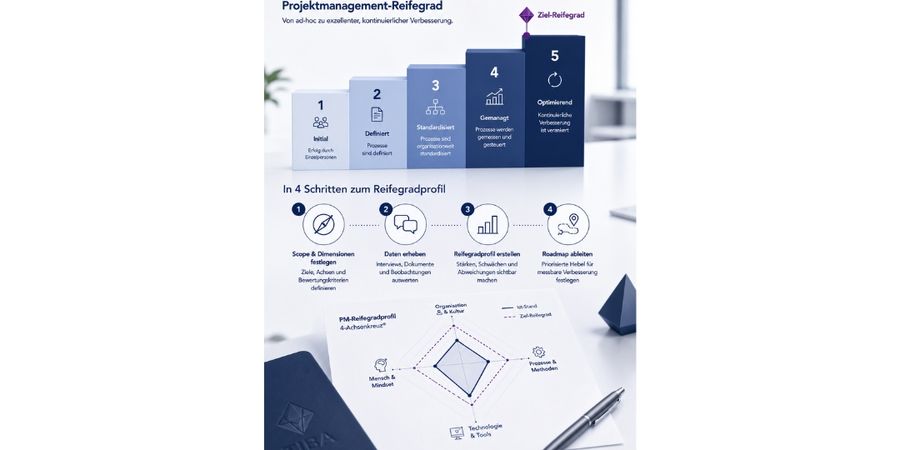
PM maturity describes how professionally, consistently and effectively an organization manages its projects. Common models, based on CMMI or IPMA Delta for instance, typically distinguish five levels: from level 1, where project success depends above all on the effort of individuals (“heroism instead of system”), through defined and organization-wide standardized processes, to level 5, where the organization continuously measures and improves its project management. One point matters: higher is not automatically better. A mid-sized plant engineering company needs a different target maturity from a group running a thousand parallel projects. What counts is the fit between maturity and business requirement.

Why the assessment is worth it

It replaces opinion with evidence.

In almost every organization there are competing narratives about what ails projects: the PMO says “lack of discipline”, the project managers say “too much bureaucracy”, the management board says “too slow”. A structured maturity assessment makes that debate objective with data, interviews and document analysis instead of anecdotes.

It prioritizes investment.

Anyone who knows that the greatest weakness lies not in the methods but, say, in multi-project control or resource management invests their budget where it has an effect, instead of buying a third methods course for a problem that is not a methods problem at all.

It creates a basis for measurement.

The current state you establish is the baseline against which every later improvement can be measured. Without it, every PM initiative stays vague.

How a maturity assessment works in practice

A sound assessment does not take months. A four-step approach has proved itself. First the scope and the dimensions to be assessed are defined. Alongside processes and methods we explicitly recommend looking at People & Mindset, Organization & Culture and Technologies & Tools as well, in other words all four axes of the Tiba 4-Achsenkreuz®. Structured interviews follow, along with an analysis of real project documents (not self-assessment questionnaires alone, which measure wishful thinking). The findings are then condensed into a maturity profile: strengths, weaknesses, differences between units. Finally, and this is what separates a good assessment from a box-ticking exercise, the profile becomes a prioritized roadmap: which three to five levers will bring the greatest progress over the next twelve months?

The three most common mistakes

We see three mistakes again and again:

First: looking only at processes.
Anyone who assesses only processes overlooks the fact that most project management problems have cultural causes.

Second: the benchmark trap.
Comparing yourself with other companies is appealing, but the only thing that should guide action is the distance to your own target maturity.

Third: the assessment that goes in a drawer.
A maturity report with no consequences was a waste. The assessment is the beginning of the transformation, not a substitute for it.

A finding from practice: when the diagnosis surprises

An anonymized example shows just how much the assessment is worth. A technology company was convinced it had a methods problem. Projects ran inconsistently, so a binding project management framework was to be introduced and taught widely. The maturity assessment produced a different picture: the methodological competence of the project managers was above average. The real finding lay on two other axes: a multi-project portfolio without prioritization, in which 40 projects competed for the same bottleneck experts, and a leadership culture in which status reports were systematically painted green because red traffic lights counted as failure. The planned training budget would have touched neither. Instead a monthly portfolio decision meeting of the management board was established and the reporting logic and escalation culture were redesigned, with a measurable effect on schedule adherence within two quarters. The point: without a diagnosis a lot of money would have gone into the wrong therapy, and the failure would afterwards have been blamed on “the methods”.

Four common questions about the PM maturity assessment

How long does a PM maturity assessment take?

For a mid-sized company typically four to six weeks, for complex organizations with several units correspondingly longer. What matters is the availability of the interview partners.

Who has to be involved in the process?

Across every level: management board, line managers, project managers, team members and explicitly the critical voices too. An assessment that only talks to supporters measures hope, not reality.

What does a PM maturity assessment cost, and what does it give us?

The assessment costs a fraction of what a single misdirected PM initiative costs. Its value lies as much in the measures it prevents as in the ones it justifies.

Do I need external support for it?

Not necessarily, but it helps. Internal assessments struggle with organizational blind spots and hierarchy effects: employees tell outsiders in confidence what they would never allow to be minuted internally.

Conclusion:

The PM maturity assessment is the most economical step of any PM transformation: it costs little, prevents wasted investment and provides the basis on which all further decisions rest. Anyone who wants to improve their project management should start with it, not with the tool.

Would you like a PM maturity assessment for your initiatives? We look forward to hearing from you by email at: contact@tiba-ttg.com 

More blogs on the topic

Project management fundamentals with a TÜV Rheinland® certificate: who the course is worth it for

Learn more

Processes & Methods, Technologies & Tools: the craft of transformation, used properly

Learn more

The PMO of the future: from controller to strategic enabler

Learn more