Transformation

Boutique consultancy instead of consulting corporation: why small teams support large transformations better

Anyone planning a transformation faces a fundamental question early on: the large consulting corporation with hundreds of consultants and global frameworks, or the specialized boutique with a small, experienced team? The answer depends on the task. For deep change initiatives, where trust, continuity and judgment matter, a great deal speaks for the boutique model. This article explains how the models differ, where the boutique plays to its strengths and how to recognize a serious provider.

What distinguishes a boutique consultancy

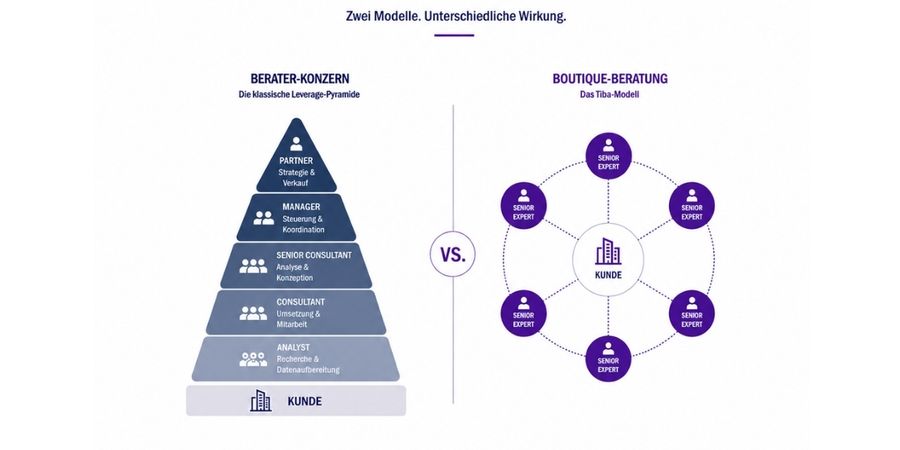
A boutique consultancy is small, specialized and staffed by senior people. It concentrates on a few core topics that it masters in depth. In our case: project management, change management and business transformation. Instead of scaling through headcount it relies on effect through experience: the people in the sales conversation are the same ones who later work on the project. There is no handover to a junior team once the contract is signed, no interchangeable supply chain of slide producers.

The opposite model is the leverage pyramid of the large consultancies: one partner is responsible for many projects at once, and the operational work is done mostly by young consultants with a few years of experience. That model is commercially rational, for the consultancy. For the client it means that a considerable part of the daily rate finances the consultants' learning curve.

Where small teams have a structural advantage

First: responsibility cannot be delegated.

In a boutique, the management is personally answerable for the result. If the project fails, it is not an anonymous engagement number that fails but the reputation of the people involved. That structure of incentives changes behavior in the project noticeably: people object when objection is needed, including to the client.

Second: experience cannot be replaced by method.

Transformations rarely fail for lack of frameworks. They fail because of people, questions of power and culture. Anyone who has supported dozens of change initiatives recognizes the patterns before they become problems: the department head who nods and blocks; the steering committee that postpones decisions; the project plan that is politically motivated and too optimistic. That experience is the real value of senior consulting.

Third: focus beats breadth.

A boutique does not have to serve every topic. It can afford to turn down enquiries that do not fit its expertise. That sounds banal, but it is a mark of quality: anyone who offers everything masters nothing in depth.

Fourth: speed through short paths.

In a boutique, decisions are made directly between client and the responsible consultant, without internal loops through practice leads, quality gates and staffing processes. In fast-moving phases of a transformation that is a measurable advantage.

Where the large consultancy is the better choice

To be fair, there are tasks the corporate model suits. Anyone who has to roll out an ERP template in twelve countries at once needs capacity across the board. So does anyone who needs a due diligence with 40 analysts in three weeks. The question is therefore not “large or small” but: what type of task is this? Capacity topics tolerate scaling. Judgment topics, strategy, transformation, culture, leadership, do not.

How to recognize a good boutique consultancy

Five questions are worth asking when choosing. Do the people named in the proposal actually work on the project later? How many years of relevant experience does the specific team have, not the company average? Can the provider name references for comparable initiatives, ideally with clients you can talk to? Does the provider ever say no when an enquiry does not fit its expertise? And how does it deal with failure, is it kept quiet or reflected on openly? That last point in particular separates marketing from substance.

How we see ourselves

Tiba Transformation Group deliberately works in the boutique format: senior-staffed, focused on project management, change management and transformation, with the methodological experience of more than 37 years and over 950 consulting engagements. Our standard can be summed up in one sentence: trust before reach, substance before volume.

An example from practice

A typical case from our engagement experience, anonymized, shows what the difference feels like in practice. A mechanical engineering company with around 12,000 employees first commissioned a large consultancy to realign its project business. After six months there were 200 slides, a target picture and an implementation plan, produced by a team half of which consisted of consultants in their first and second year. Little was implemented: the concepts were generic, the organization did not feel understood, and middle management had quietly checked out. The second attempt with a small senior team went differently, not because the methods were better, but because two experienced consultants spent three months working on real projects, with project managers and department heads, and developed the concept out of practice rather than the other way round. The result was less spectacular, but it was lived. This experience is not an isolated case, and it has a simple core: change happens in relationships, not in documents, and relationships need people with experience who stay.

Common objections and what is behind them

“A boutique does not have enough capacity for our initiative.” For pure capacity topics that is true, it is not built for them. For transformations the objection is usually a misunderstanding: there the bottleneck is rarely the number of external consultants but the absorptive capacity of your own organization. More consultants do not accelerate change, they only increase the rate of slide production. “Big names give the supervisory board confidence.” That is honest and legitimate. But it is worth knowing the insurance premium: you are paying for the brand, not for the team. Presenting the board with the concrete profiles and references of the people who will actually do the work usually creates more confidence than any logo. “Boutiques depend on individuals.” True, and that is exactly what disciplines them: a boutique cannot afford a weak team member, a corporation can.

Conclusion:

The choice of consulting model is a strategic decision, not a matter of taste. For transformations that demand judgment, continuity and personal responsibility, the boutique consultancy has a structural advantage. Do not examine the size of the provider, examine the experience of the people who will actually work with you.

Are you planning a change initiative and want to know whether a boutique approach fits? Talk to us. Without obligation and on equal terms. → Get in touch

Literature

Sources

More blogs on the topic

The Tiba 4-Achsenkreuz®: why successful transformation needs four dimensions

Learn more

Why transformations fail: five patterns we see again and again, and what helps

Learn more

Transformation consulting: what it has to deliver and which selection criteria really matter

Learn more