Transformation

Why transformations fail: five patterns we see again and again, and what helps

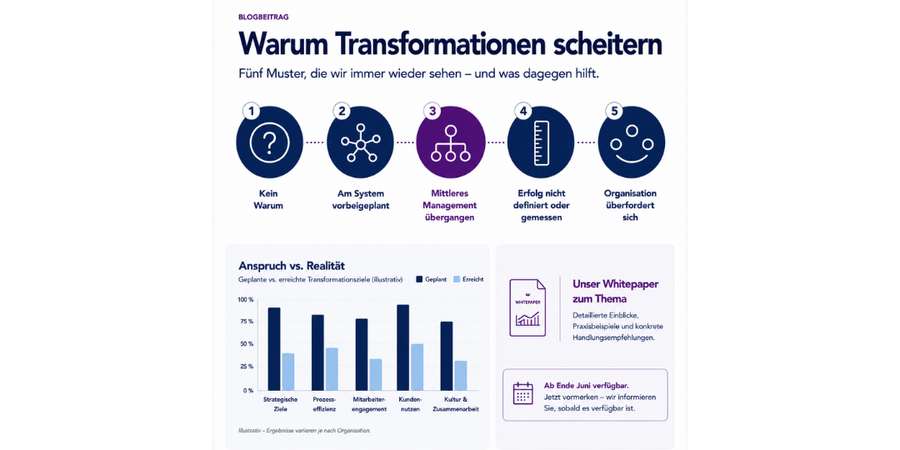
One figure has haunted management literature and conference talks for years: around 70 percent of all transformation initiatives miss their goals. The exact figure is debatable, the studies are inconsistent. What is not in dispute is the finding behind it: a substantial share of change initiatives in companies falls short of expectations, costs more than planned or quietly peters out. From more than 950 consulting engagements over three decades we know the patterns that keep repeating. Here are five of them, together with the question of what actually helps.

Contents

1. The transformation has no “why”

2. Planning that misses the system

3. Middle management is bypassed

4. Success is not defined, or not measured

5. The organization takes on too much

6. The common thread: failure is rarely a problem of method

7. How to spot the patterns in your own initiative: a self-check

8. What this means for transformations already under way

9. Conclusion

Pattern 1: the transformation has no “why”

Many initiatives start with a target picture (“become more agile”, “become more digital”, “become more efficient”) but without a convincing answer to why the change is necessary now and what happens if it does not take place. Employees sense that gap immediately. Without comprehensible urgency, change is seen as a management fashion that can be waited out. What helps: an honest business case for the change that also states the uncomfortable truths. Anyone who talks up the situation gambles away the most important capital any transformation has: credibility.

Pattern 2: planning that misses the system

Transformations are often designed as plans of measures: new processes, new tools, new organization. What is missing is the view of how they interact. A new tool without adapted processes creates frustration. New processes without changed leadership behavior stay on paper. A new organization without cultural anchoring produces the same conflicts under new labels. What helps: thinking about change consistently across several dimensions. We use the Tiba 4-Achsenkreuz® for this, with the dimensions People & Mindset, Organization & Culture, Processes & Methods, and Technologies & Tools. Which model you use is secondary; what matters is that no dimension is systematically forgotten.

Pattern 3: middle management is bypassed

The top of the company decides, the workforce is supposed to implement, and in between sits a layer of management nobody asked. Yet it is precisely that layer that decides between success and failure: department and team leaders translate the change into everyday work, or they do not. Passive resistance in middle management is rarely ill will; usually it is the rational response to unclear roles and a felt loss of control. What helps: involving middle management early and seriously, not as recipients of messages but as co-designers with real influence over the how.

Pattern 4: success is not defined, or not measured

“We want to get better” is not a goal. If nobody defines how the success of the transformation will be recognized after six, twelve and twenty-four months, any result can be talked up and any criticism deflected. Conversely, pure KPI theater leads to metrics being served without anything changing substantially. What helps: a few hard indicators with a clear link to business results, complemented by qualitative signals such as leadership feedback, sentiment readings and turnover in key roles. And regular, honest assessments whose results have consequences.

Pattern 5: the organization takes on too much

Many companies start too many initiatives at once. Each one may make sense; together they compete for the same managers, the same key people, the same energy for change. The result is an exhausted organization in which nothing is properly finished. What helps: consistent portfolio management for change initiatives: prioritize, sequence and, hardest of all, actively stop what no longer works.

The common thread: failure is rarely a problem of method

What stands out about all five patterns: none of them is a problem of method. They are about honesty, systemic thinking, participation, consistency and focus, in other words about leadership. Methods and tools are necessary craft, but they do not replace leadership decisions. That is uncomfortable, because it puts responsibility where it belongs: at the top of the organization.

How to spot the patterns in your own initiative: a self-check

The five patterns can be applied to your own initiative with a few questions, best answered honestly in a small group rather than in the large meeting where nobody contradicts anyone.

On the “why”: could three randomly chosen managers explain the urgency of the change consistently, and would that explanation stand up to a critical employee?

On systemic thinking: is there at least one concrete measure for each of the four dimensions, people, organization, processes and technology, and are they aligned with each other?

On middle management: when were department and team leaders last asked for their assessment, and did their answer have any visible consequences?

On measurability: is it written down how success will be recognized in twelve months, and who checks that and when?

On overload: how many change initiatives are running in parallel right now, and who has an overview of the total load they place on the same key people?

Anyone who hesitates on two or more of these questions does not have a bad organization, but an initiative carrying avoidable risks from the start.
What this means for transformations already under way

The good news for everyone in the middle of a transformation: none of the patterns is a death sentence as long as it is recognized. A missing “why” can be supplied later, more honestly than at the start, because by then everyone knows it was missing. A bypassed middle management can be won back if the invitation is meant seriously and comes with real influence. And an overloaded portfolio can be cleared, which costs face on the initiatives that are stopped and gains credibility with all the others. Only one thing cannot be made up for later: the right moment. Every pattern gets more expensive the longer it operates.

Conclusion:

Transformations fail on recurring, recognizable patterns, and that is exactly the good news: what can be recognized can be avoided. The condition is a willingness to examine your own initiative critically, before the patterns take effect.

Would you like to deliver your transformation successfully and anchor it in your organization? We look forward to hearing from you: Get in touch

Literature

Sources

More blogs on the topic

The Tiba 4-Achsenkreuz®: why successful transformation needs four dimensions

Learn more

Boutique consultancy instead of consulting corporation: why small teams support large transformations better

Learn more

Transformation consulting: what it has to deliver and which selection criteria really matter

Learn more