Contents
- The basic idea: transformation is a system
- What happens when one axis is missing
- How the model is used in practice
- Not a dogma, but a thinking tool
- The 4-Achsenkreuz in use: an example from practice
- How to start with the model
- Conclusion
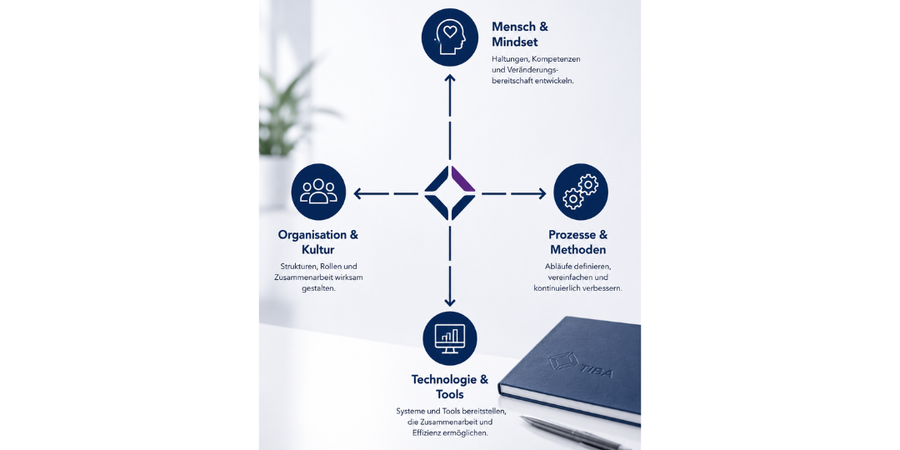
Every transformation has its favorite dimension. Technology-driven companies start with the tool, process-minded ones with the methods handbook, and others begin with a culture workshop. The problem: change that happens on only one dimension fizzles out on the others. It is precisely from this observation, distilled from decades of consulting practice, that the Tiba 4-Achsenkreuz® (Tiba 4-Axis Cross) emerged: a transformation model that makes sure transformation is thought through and delivered as a whole. In this opening piece of our three-part series on methods we introduce the model; the following articles go deeper into the individual axes.
Contents
The 4-Achsenkreuz describes four dimensions that interact in every change initiative. People & Mindset: the attitudes, skills and readiness to change of everyone involved. Organization & Culture: structures, roles, decision paths and the unwritten rules of working together. Processes & Methods: the defined workflows and the methodological craft, from stage-gate processes to agile frameworks. Technologies & Tools: the systems that carry processes and enable collaboration. The point of the model does not lie in the four terms; similar categories appear in other frameworks. It lies in the cross: the axes are connected. Every intervention on one axis produces effects, intended and unintended, on the other three.
Anyone who has lived through transformations knows the typical imbalances. A new project management tool is introduced but the processes stay undefined, and the tool becomes an expensive documentation duty (technology without processes). An agile framework is rolled out but decision rights stay in the line organization, and the new roles are labels without substance (methods without organization). A new organizational structure is announced but nobody invests in skills and acceptance, and the old ways of working live on in new boxes (organization without people). And the counterpart: workshops on mindset and culture that are followed by no structural change. The energy fizzles out and cynicism remains (people without organization and processes).
In day-to-day consulting we use the 4-Achsenkreuz in three situations. As a diagnostic grid: when analyzing an initiative or a project management organization, each axis is examined systematically. Where is the organization strong, and where does the real cause of the problems lie? Often it lies on a different axis than expected. As a planning check: every roadmap is tested against the four axes. Does the initiative contain concrete measures for each dimension, and are they aligned with each other? As a communication instrument: the cross makes it immediately clear to managers and employees that transformation is more than an IT project or a training program. In everyday work this shared map is often more valuable than any detailed methodology.
One point matters to us: the 4-Achsenkreuz is not a waterfall plan and not a certification religion. It does not prescribe where a transformation has to begin; that depends on the individual case. It only ensures that one uncomfortable question gets asked: do we have all four dimensions in view, and do our measures fit together? In our experience that single question is the difference between initiatives that have an effect and initiatives that merely keep people busy.
An anonymized example from our consulting practice shows the diagnostic effect of the model. An industrial company complained about the sluggish rollout of its new project management software. After eighteen months fewer than half the projects were using the system seriously. The reflex of those responsible: more training, a measure on the technology axis. Analysis along the axis cross produced a different picture. On the process axis the foundation was missing: there was no binding standard for which project data had to be maintained and to what quality. The tool asked for things that were defined nowhere. On the organization axis the consequence was missing: no committee used the tool data for decisions, so maintaining it had no effect. And on the people axis the benefit was missing: project managers experienced the system as an instrument of control with nothing in return. At most a quarter of the solution was technology. The rest was defining processes, a portfolio meeting that actually used the data, and redesigning the tool from the user's point of view. A year later usage was above ninety percent. The training courses that had originally been seen as the solution played the smallest part.
Getting started does not require a consulting contract, it requires ninety minutes and honesty. Take your most important current change initiative and answer four questions in the leadership team: what are we concretely doing about the attitudes and skills of the people affected? What are we changing in structures, roles and incentives? Which processes are we defining or simplifying? And what technical support does all of that need? Write the answers into the four quadrants. Two findings are typical: one axis is overloaded, usually technology or processes, and at least one is empty. In a single meeting you will have found what is otherwise diagnosed a year later as “inexplicable resistance”.
Conclusion: transformations rarely fail because one dimension was handled badly. They fail because dimensions were forgotten. The Tiba 4-Achsenkreuz® is our instrument for preventing exactly that. In the next two articles we go deeper into the pairs of axes: first People & Mindset and Organization & Culture, then Processes & Methods and Technologies & Tools.
Would you like to get to know the Tiba 4-Achsenkreuz® better and find out how to reduce your project risks for good? Register for our free live webinar and learn in detail why projects fail. The webinar is held in German.
Register for the live webinar on September 18, 2026 at 10:00 CEST
Register free of charge
Would you like to know now how well balanced your current change initiative is? Get in touch. We will review it with you along the four axes.
Send us a short email to: contact@tiba-ttg.com
We will get back to you quickly and talk it through. Honestly and without obligation.
Sources